08
February
2026
A missing stamp
The stamp that took 77 years to arrive
On July 9, 2022, amid the mass protests at Galle Face Green, demonstrators seized the President’s House. For days, long queues stretched outside the gates as people entered a space that had been sealed off from public life for a long time. Bedrooms, bathrooms, and even the swimming pool were examined with curiosity and disbelief. The building itself became an exhibit.
Amid this massive crowd, one man walked in with a purpose entirely different from the rest. While the others came to see how power had lived, he was searching for a painting. His name was Samantha Niroshana Peiris
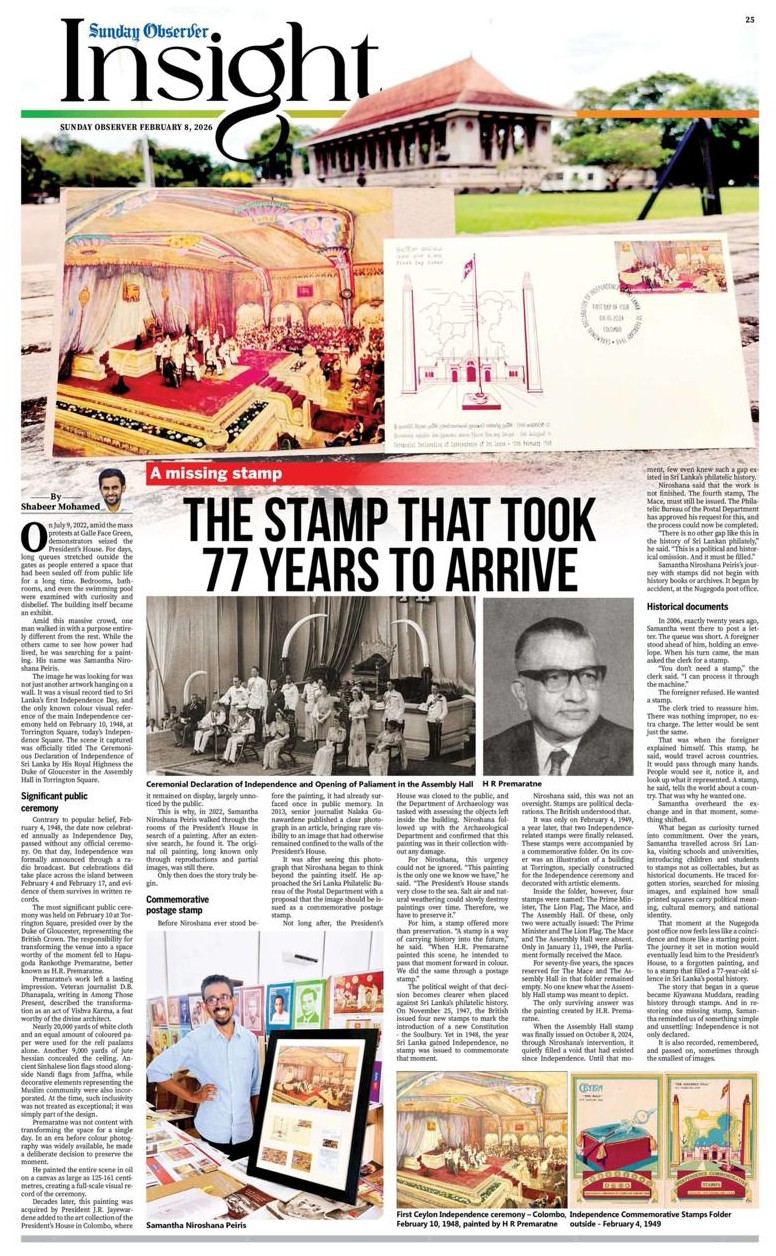
The image he was looking for was not just another artwork hanging on a wall. It was a visual record tied to Sri Lanka’s first Independence Day, and the only known colour visual reference of the main Independence ceremony held on February 10, 1948, at Torrington Square, today’s Independence Square. The scene it captured was officially titled The Ceremonious Declaration of Independence of Sri Lanka by His Royal Highness the Duke of Gloucester in the Assembly Hall in Torrington Square.
// Significant public ceremony
Contrary to popular belief, February 4, 1948, the date now celebrated annually as Independence Day, passed without any official ceremony. On that day, Independence was formally announced through a radio broadcast. But celebrations did take place across the island between February 4 and February 17, and evidence of them survives in written records.
The most significant public ceremony was held on February 10 at Torrington Square, presided over by the Duke of Gloucester, representing the British Crown. The responsibility for transforming the venue into a space worthy of the moment fell to Hapugoda Rankothge Premaratne, better known as H.R. Premaratne.
Premaratne’s work left a lasting impression. Veteran journalist D.B. Dhanapala, writing in Among Those Present, described the transformation as an act of Vishva Karma, a feat worthy of the divine architect.
Nearly 20,000 yards of white cloth and an equal amount of coloured paper were used for the reli paalams alone. Another 9,000 yards of jute hessian concealed the ceiling. Ancient Sinhalese lion flags stood alongside Nandi flags from Jaffna, while decorative elements representing the Muslim community were also incorporated. At the time, such inclusivity was not treated as exceptional; it was simply part of the design.
Premaratne was not content with transforming the space for a single day. In an era before colour photography was widely available, he made a deliberate decision to preserve the moment.
He painted the entire scene in oil on a canvas as large as 125-161 centimetres, creating a full-scale visual record of the ceremony.
Decades later, this painting was acquired by President J.R. Jayewardene and added to the art collection of the President’s House in Colombo, where it remained on display, largely unnoticed by the public.
This is why, in 2022, Samantha Niroshana Peiris walked through the rooms of the President’s House in search of a painting. After an extensive search, he found it. The original oil painting, long known only through reproductions and partial images, was still there. Only then does the story truly begin.
// Commemorative postage stamp
Before Niroshana ever stood before the painting, it had already surfaced once in public memory. In 2013, senior journalist Nalaka Gunawardene published a clear photograph in an article, bringing rare visibility to an image that had otherwise remained confined to the walls of the President’s House.
It was after seeing this photograph that Niroshana began to think beyond the painting itself. He approached the Sri Lanka Philatelic Bureau of the Postal Department with a proposal that the image should be issued as a commemorative postage stamp.
Not long after, the President’s House was closed to the public, and the Department of Archaeology was tasked with assessing the objects left inside the building. Niroshana followed up with the Archaeological Department and confirmed that this painting was in their collection without any damage.
For Niroshana, this urgency could not be ignored. “This painting is the only one we know we have,” he said. “The President’s House stands very close to the sea. Salt air and natural weathering could slowly destroy paintings over time. Therefore, we have to preserve it.”
For him, a stamp offered more than preservation. “A stamp is a way of carrying history into the future,” he said. “When H.R. Premaratne painted this scene, he intended to pass that moment forward in colour. We did the same through a postage stamp.”
The political weight of that decision becomes clearer when placed against Sri Lanka’s philatelic history. On November 25, 1947, the British issued four new stamps to mark the introduction of a new Constitution – the Soulbury. Yet in 1948, the year Sri Lanka gained Independence, no stamp was issued to commemorate that moment.
Niroshana said, this was not an oversight. Stamps are political declarations. The British understood that.
It was only on February 4, 1949, a year later, that two Independence-related stamps were finally released. These stamps were accompanied by a commemorative folder. On its cover was an illustration of a building at Torrington, specially constructed for the Independence ceremony and decorated with artistic elements.
Inside the folder, however, four stamps were named: The Prime Minister, The Lion Flag, The Mace, and The Assembly Hall. Of these, only two were actually issued: The Prime Minister and The Lion Flag. The Mace and The Assembly Hall were absent. Only in January 11, 1949, the Parliament formally received the Mace.
For seventy-five years, the spaces reserved for The Mace and The Assembly Hall in that folder remained empty. No one knew what the Assembly Hall stamp was meant to depict.
The only surviving answer was the painting created by H.R. Premaratne.
When the Assembly Hall stamp was finally issued on October 8, 2024, through Niroshana’s intervention, it quietly filled a void that had existed since Independence. Until that moment, few even knew such a gap existed in Sri Lanka’s philatelic history.
Niroshana said that the work is not finished. The fourth stamp, The Mace, must still be issued. The Philatelic Bureau of the Postal Department has approved his request for this, and the process could now be completed.
“There is no other gap like this in the history of Sri Lankan philately,” he said. “This is a political and historical omission. And it must be filled.”
Samantha Niroshana Peiris’s journey with stamps did not begin with history books or archives. It began by accident, at the Nugegoda post office.
// Historical documents
In 2006, exactly twenty years ago, Samantha went there to post a letter. The queue was short. A foreigner stood ahead of him, holding an envelope. When his turn came, the man asked the clerk for a stamp.
“You don’t need a stamp,” the clerk said. “I can process it through the machine.”
The foreigner refused. He wanted a stamp. The clerk tried to reassure him. There was nothing improper, no extra charge. The letter would be sent just the same.
That was when the foreigner explained himself. This stamp, he said, would travel across countries. It would pass through many hands. People would see it, notice it, and look up what it represented. A stamp, he said, tells the world about a country. That was why he wanted one.
Samantha overheard the exchange, and in that moment, something shifted.
What began as curiosity turned into commitment. Over the years, Samantha travelled across Sri Lanka, visiting schools and universities, introducing children and students to stamps not as collectables, but as historical documents. He traced forgotten stories, searched for missing images, and explained how small printed squares carry political meaning, cultural memory, and national identity.
That moment at the Nugegoda post office now feels less like a coincidence and more like a starting point. The journey it set in motion would eventually lead him to the President’s House, to a forgotten painting, and to a stamp that filled a 77-year-old silence in Sri Lanka’s postal history.
The story that began in a queue became Kiyawana Muddara, reading history through stamps. And in restoring one missing stamp, Samantha reminded us of something simple and unsettling: Independence is not only declared.
It is also recorded, remembered, and passed on, sometimes through the smallest of images.
Read Here: https://www.sundayobserver.lk/.../the-stamp-that-took-77.../

© kiyawanamuddara 2020 | Solution by 4meli.com
 +94777785607



 readingstamps@gmail.com